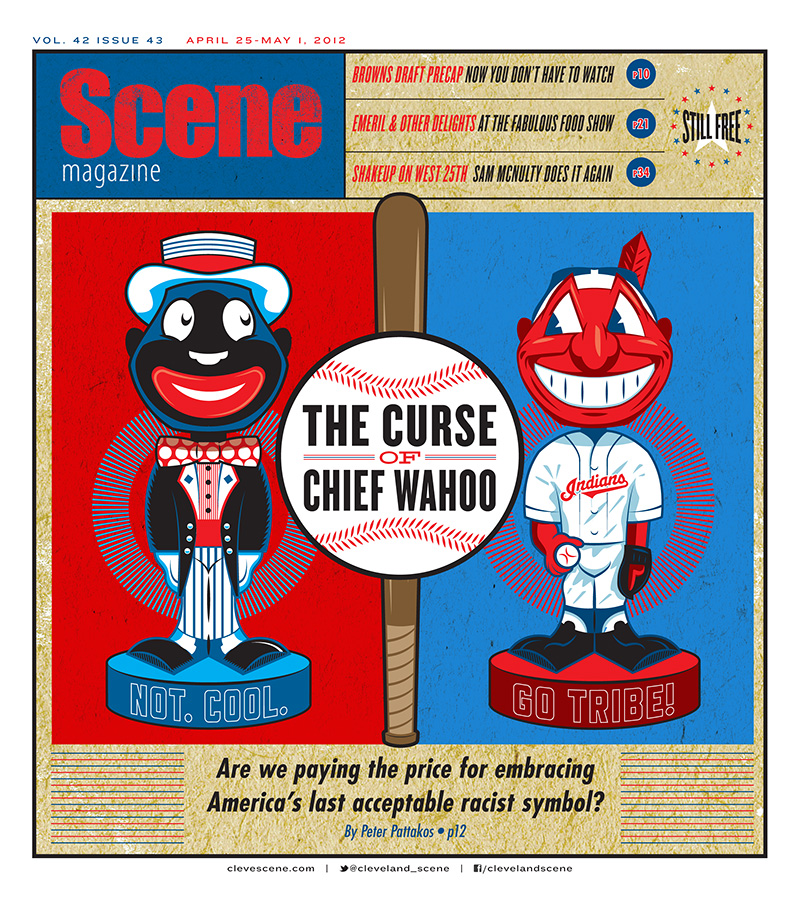
Whatever one thinks of Chief Wahoo, the face of the Cleveland Indians, one must find remarkable that so few people talk about a “Curse of Chief Wahoo” here in Cleveland, the city suffering the longest and arguably most painful championship drought in major American professional sports.
Surveys show that an overwhelming majority of Americans prefer to believe in some metaphysical order, so it’s no surprise that as bad results accumulate, speculation about the metaphysical source of those results -- a curse -- is soon to follow. So, if the Boston Red Sox had to endure an
86-year curse for trading Babe Ruth, and if the Chicago Cubs have been
cursed for the last 63 years simply because they wouldn’t let a Greek bring his Billy Goat to a ballgame, why don’t more believe that the Indians, if not all Cleveland franchises, have been cursed for what many view as a hateful affront to the entirety of Native American culture and a callous disrespect for the beginnings of American history? The answer to this question lies in understanding that for a great many, if not most, Indians fans, Chief Wahoo represents something entirely different. It’s long past time for us to come to terms with the Chief. This will not happen until the activists and others who are so convinced of Wahoo’s evil can understand the good that he represents to so many others.

To understand why Chief Wahoo has endured for so long in this world that long ago turned Bullets into Wizards, and Redskins and Redmen into Red Hawks and a Red Storm, one must also understand that for so many Tribe fans, Wahoo represents the very best of “Take me out to the Ballgame.” In Northeast Ohio, one can live in beautiful country that is only a short trip away from a relatively big city. It’s no surprise that many choose to do this. And because such a small percentage of Tribe fans live in Cleveland proper, so much of the joy of going to a ballgame is inseparable with the joy of coming to the big city on the big lake. For so many of us, our first trips to the Stadium were our first times in any real city. So many of us can remember the wonder that came with seeing the bridges over the Cuyahoga for the first time, standing in the Flats and looking up at the city on the cliff, or craning our necks to try to see the top of the first skyscrapers that we’d ever seen. Our parents didn’t want to get stuck in post-game traffic in the Stadium lot. So they parked at the Terminal Tower, or in the Muni Lot, or southwest in the Flats, or southeast by the Greyhound station, and we made the trek through the city to the Stadium together with so many others of all shapes and colors. And many of us had never seen so many different people of so many different shapes and colors. And we saw, many of us for the first time, that those people were no different from us – at least because we all wanted the home team to win.

And at the end of this fascinating trek, as we crossed Route 2 and approached the magnificent structure on the lake, we saw it;
the 35-foot tall neon-lit Chief Wahoo of glass and steel, perched atop the southeast corner of the Stadium roof, eyes gleaming, smile beaming, bat cocked, leg raised, ready to knock the next pitch all the way back down to Youngstown. And we didn’t think of Native Americans, or any kind of person at all. All of the magic of the trip to the ballpark coalesced in that smiling slugging alien angel of joy as we entered the Stadium gates. And then there was the magic of the ballgame itself, with Wahoo smiling in approval all the while -- from the stadium roof, our heroes’ uniforms, and seemingly everywhere else. Indians executive Bob DiBiasio touched on this
when he told the New York Daily News in March 2007 that, "[w]hen some people look at our logo they see baseball . . . They see Bob Feller and Omar Vizquel and Larry Doby.”
Those who want to bury Wahoo have to acknowledge why he has lasted so long -- that in doing so they would be burying more than a racist caricature; they would be burying a part of our childhood and our culture. They must acknowledge that our collective attachment to Wahoo has little to nothing to do with an intent to disparage a race of people. So much of the resistance to attempts to get rid of Wahoo is a natural reaction by Tribe fans who feel that those who protest Wahoo are accusing them of racism, and telling them that there is something fundamentally wrong with those magical trips to the ballgame. This would offend anyone’s sense of justice. These activists must acknowledge the innocent aspects of our attachment to Wahoo before their appeals to his harmful effect will ever be well-received.
Once Tribe fans believe that our love for Wahoo is understood, we will be more apt to ask ourselves why we would want to be attached any longer to a symbol as potentially demeaning to a race of people as Wahoo is.

An honest examination of Wahoo’s origins would be a good place to start in answering this question. Any such look back gives lie to the company line that the Cleveland baseball franchise was named “Indians” to honor former Cleveland second baseman Louis Sockalexis, the first Native American to play Major League Baseball.
According to an October 2007 story in a Maine newspaper, the Kennebec Journal, for which the reporter interviewed the author of a book on Sockalexis, Sockalexis’ arrival in Cleveland in 1897 “created such a sir that local newspapers jokingly dubbed his team, the Cleveland Spiders, the ‘Cleveland Indians.’” This was not done to honor Sockalexis’ Native American heritage, but rather because, "[r]acism was accepted in journalism in that day . . . Sportswriters would write things like, 'He's gonna be scalping people.'" Sockalexis was “burdened by alcohol abuse and racist taunts from opposing players and fans,” and his time with the Indians was short, ending in 1899.

In 1915, two years after Sockalexis’ death, the president of the Cleveland ball club enlisted the help of local sportswriters to rename the team, then called the “Naps” after star Napoleon “Nap” Lajoie, who had recently been traded to Oakland. The name “Indians” was chosen by the sportswriters.
According to research conducted by the Committee of 500 Years of Dignity and Resistance, none of the four daily Cleveland newspapers mentioned Sockalexis in reporting the name change. Three of these four reports (
available here) refer to stereotypes about Native Americans. A January 17, 1915 report in the Cleveland Leader reported that “[i]n place of the Naps, we’ll have the Indians, on the warpath all the time, and eager for scalps to dangle at their belts.” The Plain Dealer of the same day included a cartoon titled “Ki Yi Waugh Woop! They’re Indians.” This cartoon (pictured above) depicts, among other things, a frowning umpire scolding a Native American: “When you talk to me, talk English, you wukoig.” “Wukoig,” according to the Plain Dealer cartoon, is an “Indian” word.
After reading these reports it should be difficult to disagree with
Kansas City Star sportswriter and Cleveland native Joe Posnanski, who “find[s] that this Sockalexis story might be a bit exaggerated or, more to the point, complete bullcrap.” Posnanski points out that “the story never made much sense to begin with” because it raises the question: “Why exactly would people in Cleveland — this in a time when native Americans were generally viewed as subhuman in America — name their team after a relatively minor and certainly troubled outfielder?” Of course, they didn’t.

But despite the dubious origins of the name “Indians,” at least the name could conceivably honor Native Americans, something that Chief Wahoo could never do. Choctaw Nation member Gavin Clarkson, who teaches Native American Studies at the University of Michigan,
points out that Wahoo reinforces the image of Indians as "anachronistic savages." Charlene Teters, member of the Spokane Nation and founder of the National Coalition on Racism in Sports and the Media
told the Plain Dealer in April 2008, that Wahoo is “the most offensive racial icon in the country” and that his existence “really speaks to how invisible native people are in this country.”
With alcoholism, unemployment, and poverty plaguing Native reservations across America, a grinning, hook-nosed, fire engine red-faced caricature that reinforces beliefs that Natives are subhuman is particularly harmful. What’s worse,
as Esquire Magazine's Scott Raab has pointed out, is that Wahoo “could be interpreted as mocking the genocide of our nation's First Peoples.” New York Daily News columnist Filip Bondy
puts this more pointedly: “One race can't commit genocide against another, then turn that race into a mascot. A soccer team in Hamburg would never call itself the Jews and adorn its uniforms with caricatures.”

With Wahoo seemingly standing alone as the only racist caricature currently accepted in American society, it’s hard to tell Natives like the ones quoted above to “lighten up.” Blackface has long since been understood to be unacceptable in this country, yet redface is alive and well here in Cleveland. How else to explain this disparity if Ms. Teters isn’t at least partially correct about the invisibility of Natives in America? So do we really want to be a part of reinforcing this invisibility? An insensitivity to these matters that was more understandable in the less integrated society of our parents’ day must certainly be much less so now. At some point our intention – the innocence behind our attachment to Wahoo -- ceases to matter.

Which brings us back to the Curse. Native voices have told us loudly and clearly that Wahoo offends; and given his origins and singular status among racial caricatures in America, it’s not at all hard to see how this might be true. If there is at least one Native in this country for whom Wahoo reasonably reinforces a belief that her or his race is invisible or subhuman -- thus making it even a little bit harder to engage in life’s everyday struggle -- isn’t that enough to bring a curse on our sports teams? It sure seems worse than trading Babe Ruth or banning goats from a ballpark. So why would we even want to take this chance? Haven’t we all had enough of the exquisitely painful losing? There are a lot of Natives buried in these parts. If it’s not the Curse of Chief Wahoo, what else could it be? What else would we want it to be? At least a Curse of Chief Wahoo makes sense. At least it’s a curse that we might do something to end.

So let’s not hesitate in giving Wahoo a dignified burial. In doing so, we should recognize that while Wahoo might have been born out of something bad, he turned into something very good for many of us. We should acknowledge the complexity of the lives of both persons and personifications. And we should acknowledge progress. We need not abandon the name “Indians,” and
we have no shortage of persons indigenous to Northeast Ohio who would be worthy models for a new logo; one that truly honors Native Americans. We could call him, simply, “The Chief.”
Click
here to sign an online petition to help end the Curse of Chief Wahoo and help bring a championship to Cleveland, and please pass this on.