One significantly under-remembered fact about Art Modell is that he was sued by Browns season-ticket holders when he moved the franchise to Baltimore after the 1995 NFL season. The plaintiffs were a class representing all 1995 Browns season ticket holders, and they sued Modell and the Browns for fraud, breach of contract, and violations of the Ohio Consumer Sales Practices Act, with all claims relating to plaintiffs’ “right of first refusal” on tickets for the following season. This “right of first refusal” was a precursor to the Personal Seat Licenses (PSLs) of today that was an element of the package sold to the plaintiffs before Modell moved the team. In sum, the season-ticket holders alleged that Modell & Co. sold them a right that they never had a chance to exercise thanks to the Browns’ surprise move to Baltimore and that they were owed a refund for that.
Modell and his partners ended up settling the case for $3 million after the Court (Judge Kenneth R. Callahan, Ret., Cuyahoga County Common Pleas) ruled in the plaintiffs’ favor on defendants’ summary judgment motion. Which would be water long under the bridge by now if there weren’t still folks in Baltimore making arguments (however half-hearted or half-witted) that Modell suddenly deserves to be in Pro Football’s Hall of Fame now that he’s passed away. But since Modell is a finalist for the Hall for the first time since 2004, up for a vote by the Selection Committee this Saturday, the lawsuit is now as relevant as ever, especially because some of the documents filed in it set forth the case against Modell’s enshrinement as concisely as any source that’s out there (See also @jimkanicki’s post on the subject here).
So, I work at a law firm, Cohen Rosenthal & Kramer, that was founded in part by the two Cleveland attorneys, Josh Cohen and Ellen Kramer, who brought the case against Modell, and was able to dig into the case file a bit, the most interesting part of which for now being Plaintiffs’ Opposition to Modell’s Motion for Summary Judgment. This document, as well as any, sets forth the pattern by which Modell lied to the people of Cleveland, and, like most summary judgment papers, cites a number of authenticated documents and pages of sworn deposition testimony. This includes pages from Bill Belichick’s personal notebook, and testimony from the likes of Belichick, Modell and Al Lerner themselves. I’ve posted the document here (and below), along with some of Belichick’s handwritten notes referenced therein, and will get into some of the highlights (lowlights) below.
Again, here is a link to a copy of the brief against Modell, and here’s a link to a copy of Belichick’s handwritten notes. Now for the high(low)lights, starting with some of Modell’s public promises that he wouldn’t move the Browns out of Cleveland.
In a February 1994 Plain Dealer front page exclusive interview with Modell, the owner assured the public that the Browns would never leave Cleveland on his watch or otherwise:
“The questions and answers focused on the Browns’ expectations in negotiating with the City, which had just begun. … During the interview, Modell [said] that the Browns would remain ‘in Cleveland [for] as long as his family own[ed]’ them.” Modell added “that it might become ‘economically impossible for his team to ‘compete’ if the City failed to make the concessions he was seeking, [but that] would compel Modell only to consider selling the Browns, not to [move the franchise out of Cleveland]. Modell used strong language to emphasize this point: “I’m not about to rape this city as others in this league and others have done …. You’ll never hear me say, ‘If I don’t get this I’m moving. You can go to press on that one. I couldn’t live with myself if I did that.” – Page 6, Footnotes 23-25
Almost a full year later, Modell renewed this promise:
“In a January, 1995 interview with Browns News Illustrated, the team’s official publication[, Modell said]: “I wouldn’t consider moving the team … If I don’t get a new stadium or a refurbished stadium by the end of the current sublease, I’m not going to move the team. But I will sell the team to someone who might move it. – P 7, FN 27-28
As it turned out, however,
“Modell’s pledge was a sham, intended only to keep the heat off the Browns while they tried to secure an advantageous stadium deal. From the time lease negotiations began, Modell intended to rob Cleveland of its football team if the City did not accede to the concessions he was seeking. Modell’s lawyers were explicitly making this threat behind closed doors in January, 1994, even before the owner’s gallant promise not to “rape” the city with such tactics.” – P 8-10, FN 29-37.
Al Lerner, Modell’s accomplice in the heist by all credible accounts, had an explanation for the vast discrepancies between Modell’s public statements and behind-closed-doors threats that only a billionaire could understand:
“The man [is] speaking in two different forums; one .. to the board of directors, another for public consumption. I would assume that what [Modell] says in a magazine is done to influence events, and … what he says at a board meeting is done to report on events.” — P 11, FN 38
To Lerner,
“[The two versions] did not have to necessarily match up with each other.” – P 11, FN 39
For his part, Modell couldn’t help but acknowledge that fans were “stunned by the announcement [of the move].”
“Absolutely, absolutely, I had no choice, I wasn’t gonna give them a forewarning.” – P 11, FN 40
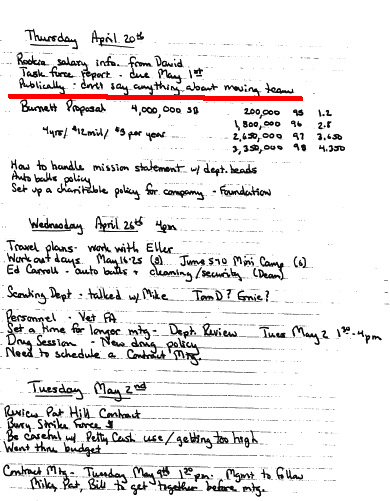
And even an April 20, 1995 entry from Bill Belichick’s personal notebook contained an entry, “recording a directive given by [a] Browns executive,” stating,
“Publicly don’t say anything about moving the team.” – P 12, FN 41-42
By October of 1995, the Browns were still denying the move despite having “consummated” the deal with Baltimore, including through Modell’s son David, who unequivocally assured talk radio callers who asked about a “potential” move as follows:
“That’s baloney. No, no, no, [there is absolutely no truth to that]. Nothing. [Cleveland] is my home … where I’ve grown up. This is where all my kids are being raised. This is where – this is – this is my home.”
While Art had at times said he might sell the team to someone who might move the team if it became “economically impossible” to do otherwise, he “never publicly indicated that this contingency had come to pass,” and in fact, at no time in ’94 or ’95 did he even consider selling the Browns.
And about those repairs that Modell said he so badly needed Cleveland to pay for, to the Stadium that he himself called “a danger to society”:
“[Cleveland Stadium Corporation, or CSC] — the company that Modell controlled and partially owned — bore the explicit duty under its lease with the City to maintain the Stadium at ‘its own expense’ in ‘good and safe repair.’ This obligation required CSC to remedy all physical problems both ‘inside and outside’ the facility, regardless of whether they were ‘structural or non-structural, extraordinary or ordinary’ In negotiating a new stadium deal, Modell was looking to the City to expend public money for repairs that he himself (through CSC) should have performed in the first place … [But] CSC chose to enrich its owners rather than apply profits to keeping the Stadium “in good and safe repair” … Half of the company belonged to Alfred Lerner … [who] admitted to receiving as much as $200,000 annually from CSC on the basis of his fifty-percent interest. … Modell owned the other half of the company.
“[Additionally], Modell’s lease with the city for Municipal Stadium required the Browns “to hold and maintain its exclusive NFL franchise for ‘the City of Cleveland … and not to do … anything which will cause … [it] to be lost or impaired in any respect, or transferred to any other city or location, or modified to permit the Browns to play [elsewhere].”-P 3-4, FN 6-16
So again, it’s not at all just about Modell’s plainly lacking qualifications for the Hall apart from the move, but just as much about his disqualifying acts in taking the Browns away to Baltimore; the worst kind of precursor to the “sports welfare for billionaires” culture that’s since become a regressive norm.
How does this guy get in the Hall by any way but a massive failure in the Selection Committee’s process? Wouldn’t it be interesting to hear an answer as to whether Modell’s Cleveland attorneys in the above-discussed lawsuit believe he deserves to get in and why? Maybe someone on the Selection Committee can get them on the phone. Anyway, the above is all public record, so if there were anything to be used in support of Modell’s Hall of Fame case in his own briefs, surely someone in Baltimore would have published it by now.
—————
RELATED: “You can’t write the history of Pro Football without Art Modell”